Documentation Index
Fetch the complete documentation index at: https://modelcontextprotocol.io/llms.txt Use this file to discover all available pages before exploring further.
Protocol eras
How the Inspector negotiates legacy vs. modern MCP, and how every feature is handled between protocol eras
The 2026-07-28 revision of MCP made substantial changes to the protocol. The Inspector therefore treats protocol era (legacy or modern, meaning before or as of that revision) as a first-class, per-server setting, orthogonal to the transport: the same HTTP URL can be inspected as a legacy server or as a modern one. Several tabs render meaningfully different UI and traffic depending on which era is in effect.
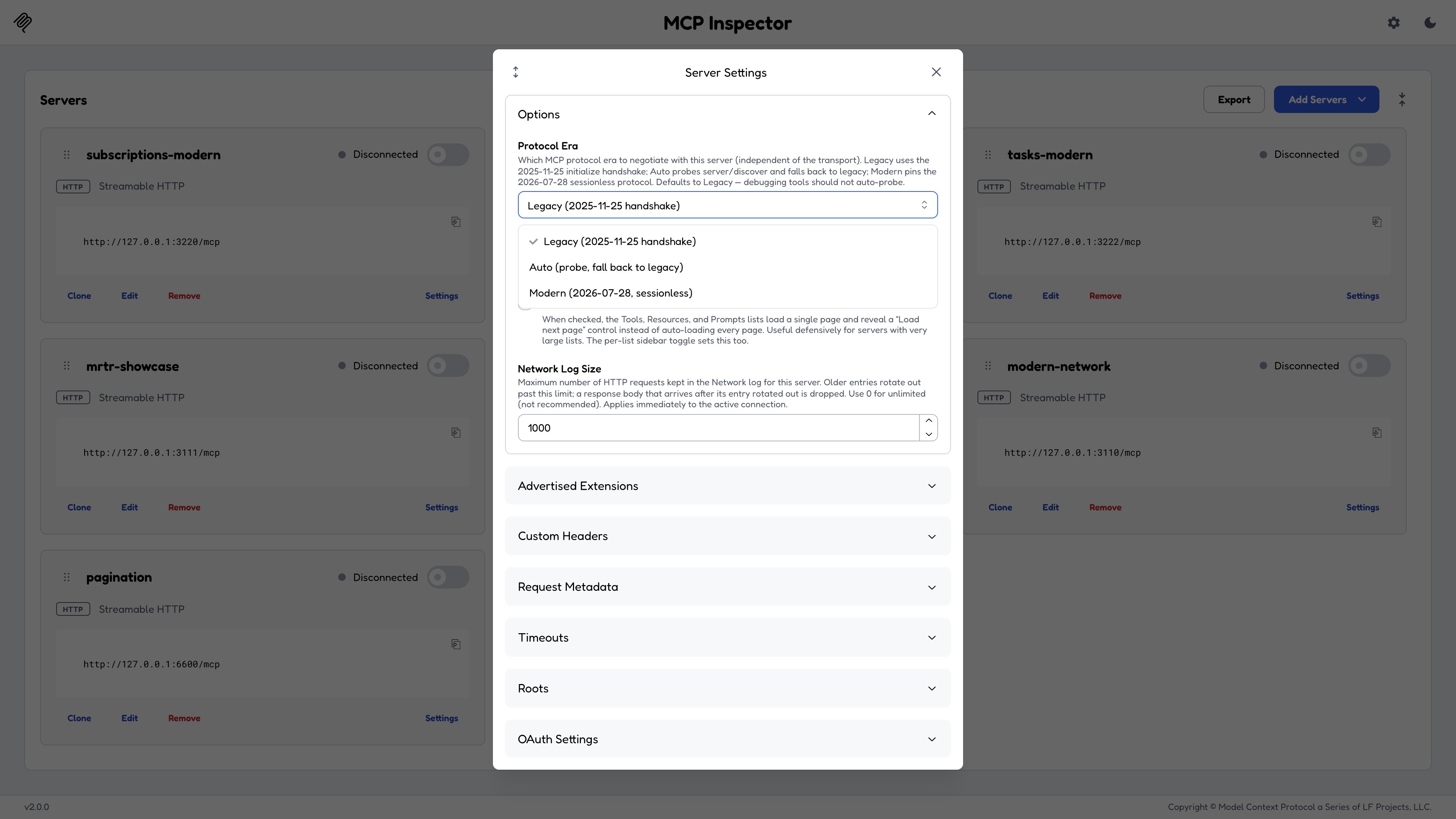
The Protocol Era setting
Each server carries a protocolEra of legacy, auto, or modern. In the web client it lives in Server Settings; in a catalog or config file it is the protocolEra field; in the CLI and TUI it comes from that same file.
| Era | What the Inspector does at connect |
|---|---|
legacy | The default. Plain initialize, no probing at all. |
auto | Probe server/discover first, and fall back to initialize on any non-modern outcome. |
modern | Pin exactly 2026-07-28. No fallback, so a non-modern server fails loudly. |
<Note>
Why legacy is the default, and not auto. A debugging tool must not
auto-probe. A server/discover probe stalls against silent legacy stdio
servers, and it pollutes the recorded transcript you came here to read. Opting
into auto or modern is a deliberate act, so what you see in the Protocol
tab is what your server would have seen from a client behaving the way you
configured.
Era selection works the same way in all three clients.
Once connected, the negotiated era is reported in the connection header and in Connection Info. On a modern connection, server/discover also supplies capabilities (including extensions), instructions, and the list of supportedVersions. The server’s name and version arrive in the result _meta under io.modelcontextprotocol/serverInfo.
Reproducing each era locally
Every section below ends with a Reproduce with … pointer to a JSON config for one of the composable test servers shipped in the Inspector repository. Clone the repo, build the test servers, then point the Inspector at the config the section names.
git clone https://github.com/modelcontextprotocol/inspector
cd inspector && npm install && npm run build
cd clients/web && npm run test-servers:build
Logging
<Tabs>
logging/setLevel once, and the server emits notifications/message at or above that level for the rest of the session.
The **Logs** tab shows a **Set Active Level** selector plus a **Set** button. Choose a level, click Set, and subsequent server logs stream into the panel.

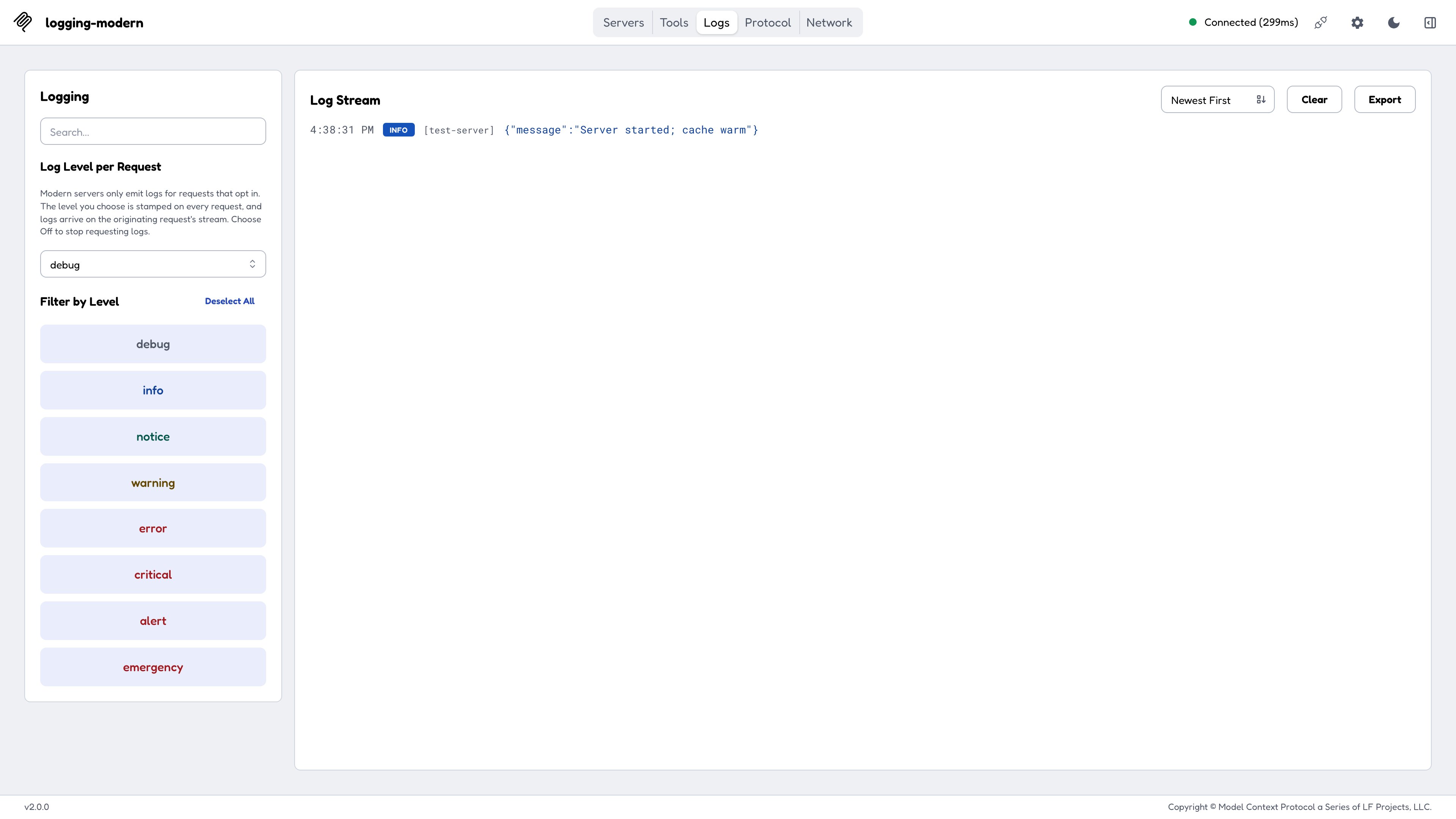
Reproduce with `test-servers/configs/logging-legacy-http.json`.The **Logs** tab therefore shows a **Log Level per Request** control instead. Pick a level and every subsequent request carries the stamp, visible in the Network tab's request body. Logs emitted while handling a request ride that request's SSE response stream.
Set the control to **Off** and the `logLevel` key is omitted entirely, so the same tool call produces no logs at all. That silence is correct behavior, not a bug.
The per-server default is `debug` (opted in at the most verbose level, since the Inspector is a debugging tool); set `modernLogLevel: "off"` on a server to opt back out by default.
Reproduce with `test-servers/configs/logging-modern-http.json`.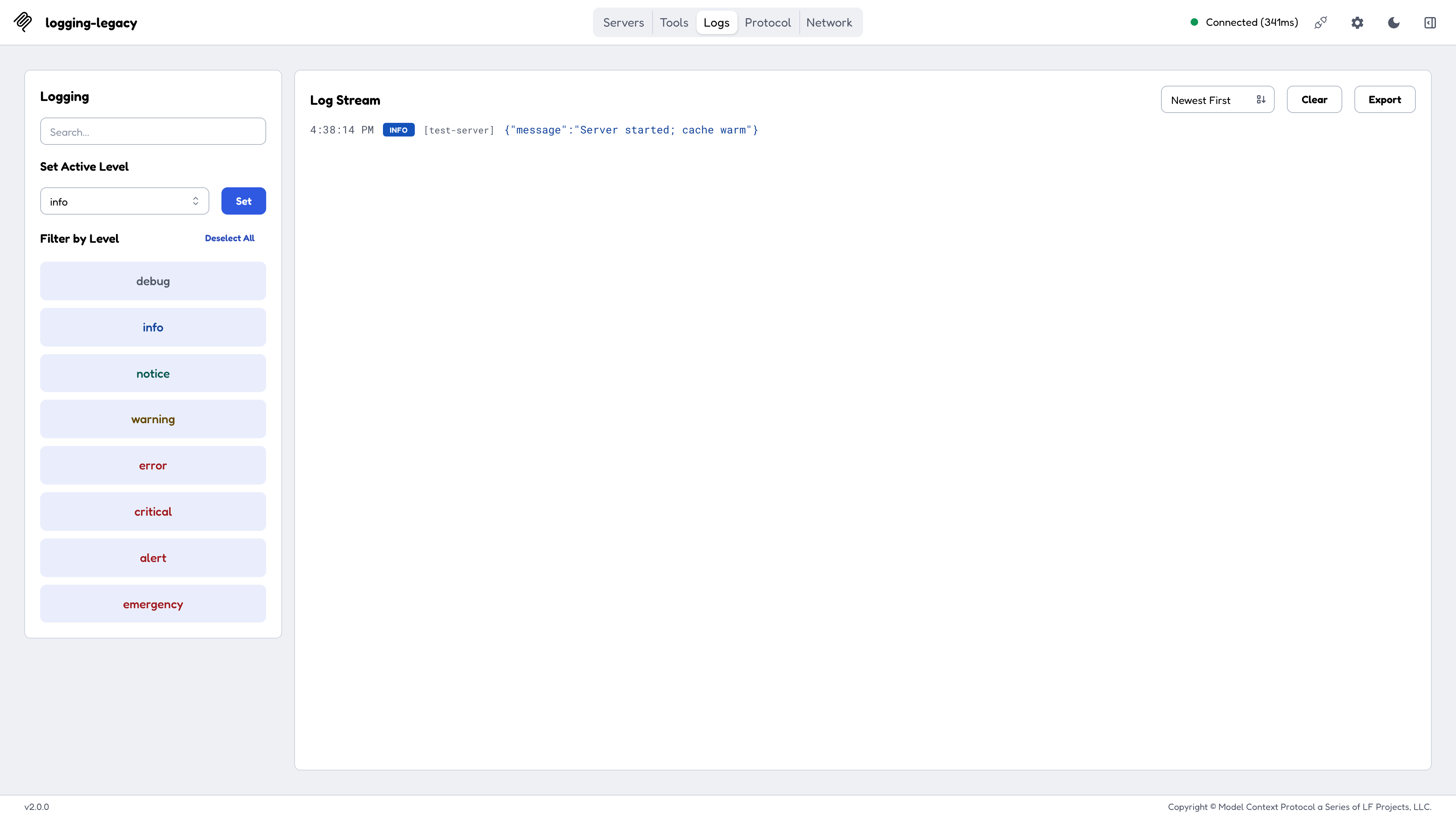
Resource subscriptions
<Tabs>
resources/subscribe. The Subscriptions section lists the URI with no stream chrome. When the resource changes, the server emits notifications/resources/updated and the subscribed tile’s last-updated time is stamped.
Reproduce with `test-servers/configs/subscriptions-legacy-http.json`, which also serves an `update_resource` tool so you can drive the notification round-trip yourself.Because the subscription is now a long-lived stream rather than a session flag, the Subscriptions section grows a **stream-status badge** in its header that moves from `Connecting...` to `Listening`. If the stream drops, the Inspector reconnects by re-sending `subscriptions/listen`.
Reproduce with `test-servers/configs/subscriptions-modern-http.json`.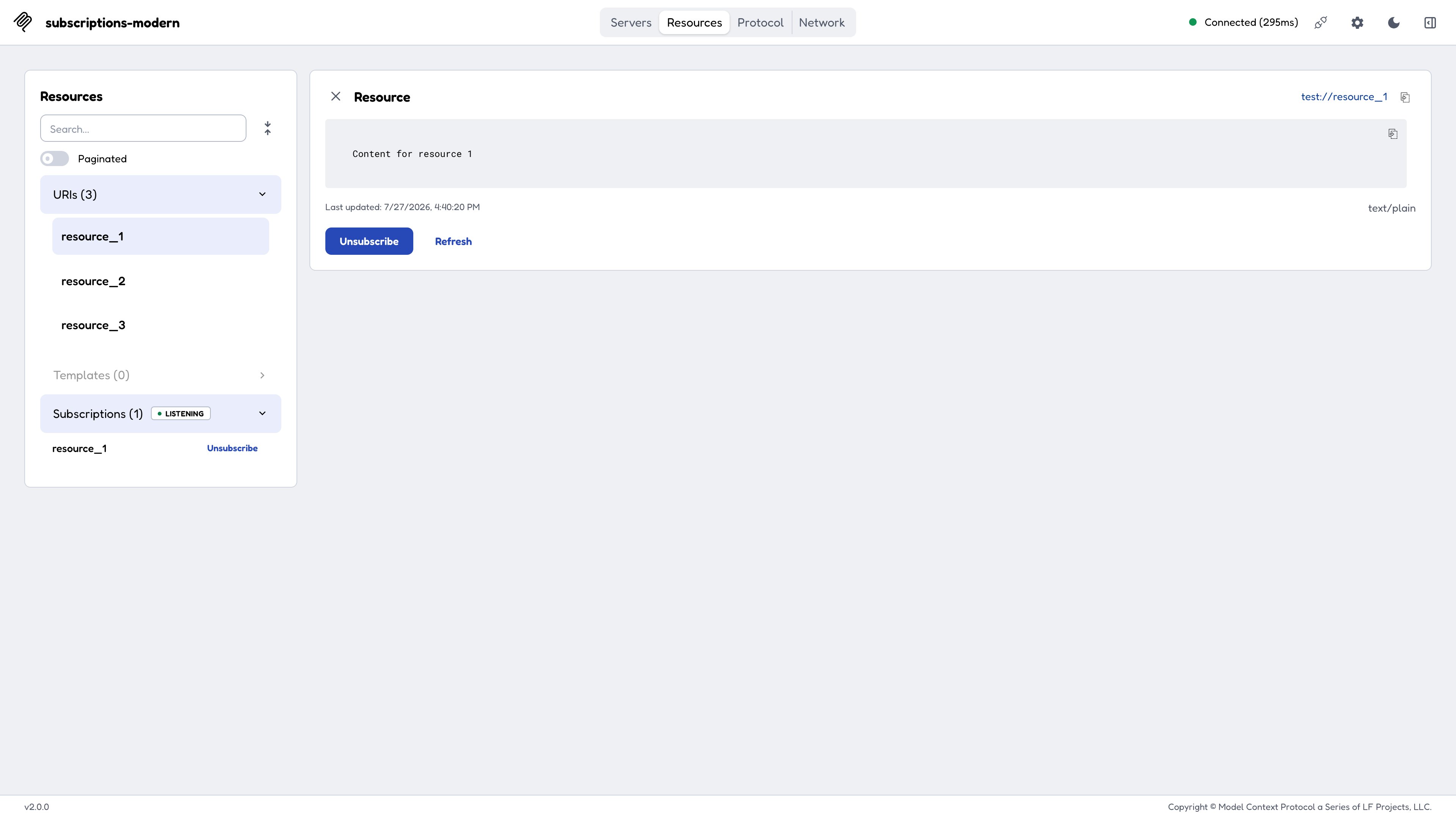
Tasks
Tasks change the most between protocol eras, including how the Inspector UI tab is gated.
<Tabs>
capabilities.tasks. Run a tool with Run as task enabled and the tab lists it, populated by tasks/list and polled with tasks/get. The completed payload is fetched with a blocking tasks/result, and Cancel sends tasks/cancel.
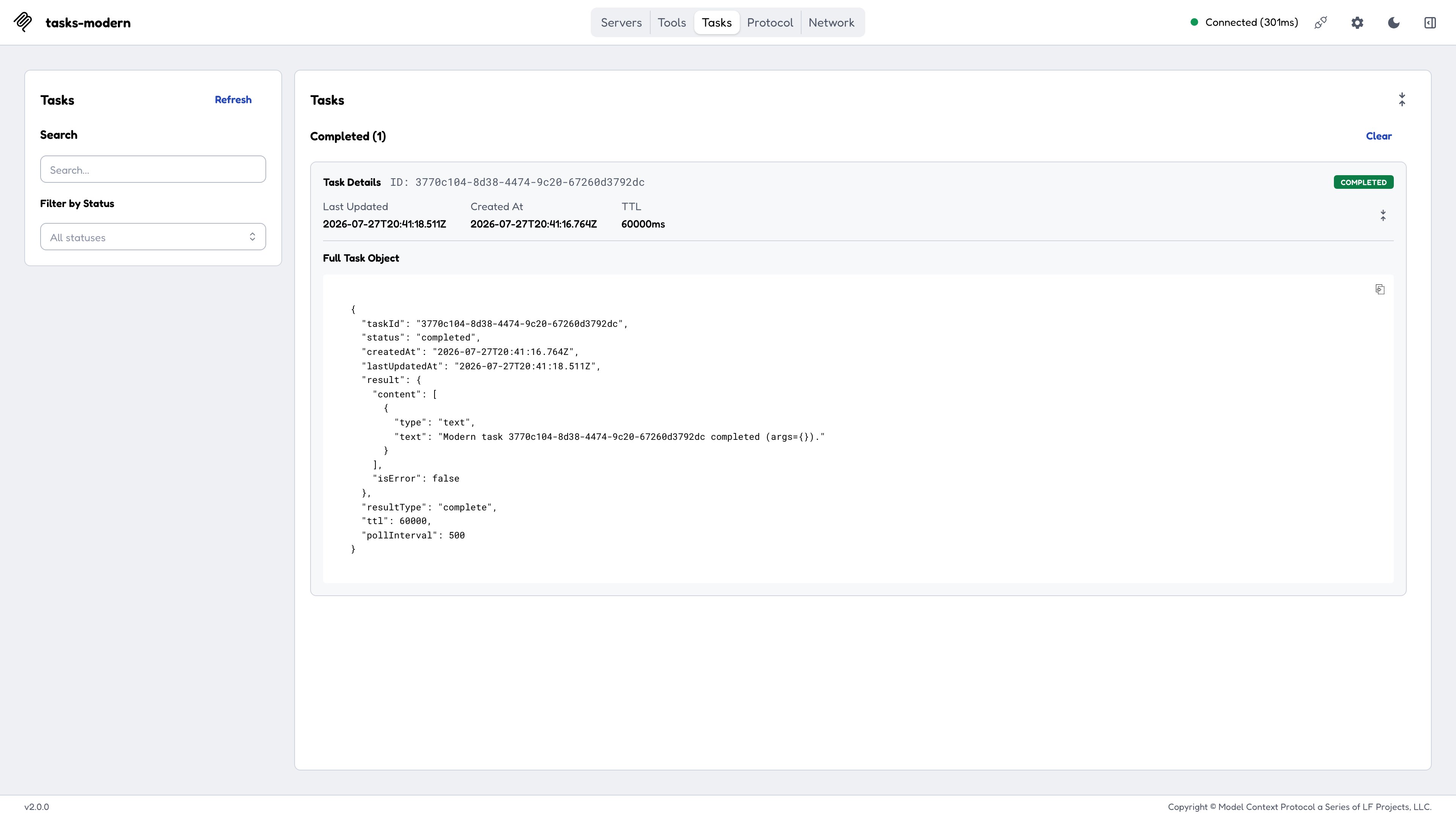
Reproduce with `test-servers/configs/tasks-legacy-http.json`.Run a tool as a task and `tools/call` returns a `CreateTaskResult` (`resultType: "task"`, visible in the Protocol and Network tabs). The Inspector polls **`tasks/get`** only; there is no `tasks/list`, so **Refresh** re-polls the handles the client already knows about. A completed task **inlines its result**, with no blocking `tasks/result` call.
A task that needs more information moves to `input_required` and surfaces an embedded [elicitation](https://modelcontextprotocol.io/specification/draft/client/elicitation) in the pending-request modal (the dialog the web client opens whenever a request is waiting on you). Answering it sends **`tasks/update`** carrying the `inputResponses`, and the next poll completes.
Reproduce with `test-servers/configs/tasks-modern-http.json` (tools `modern_task` and `modern_input_task`).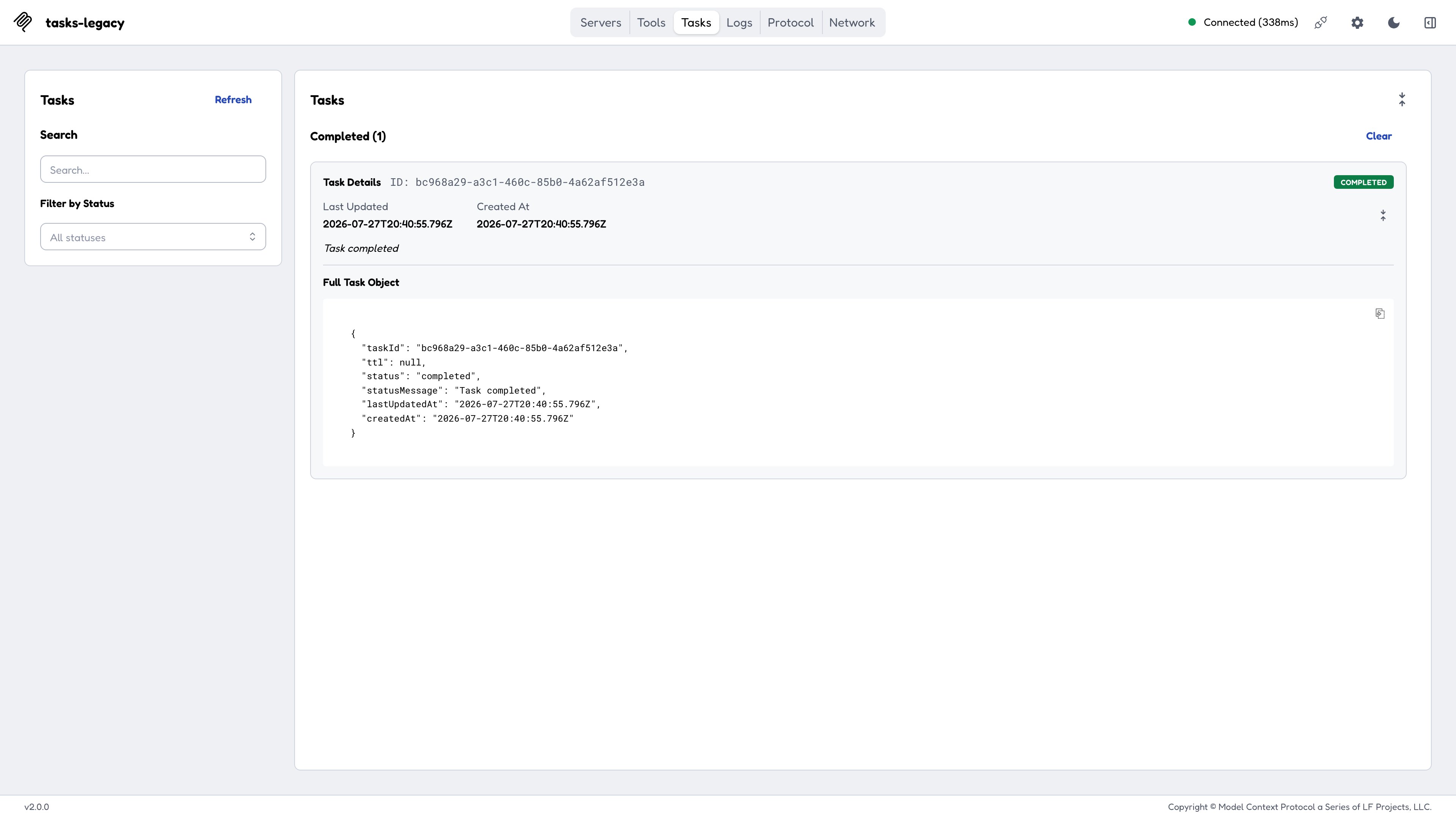
Multi-round tool results (MRTR)
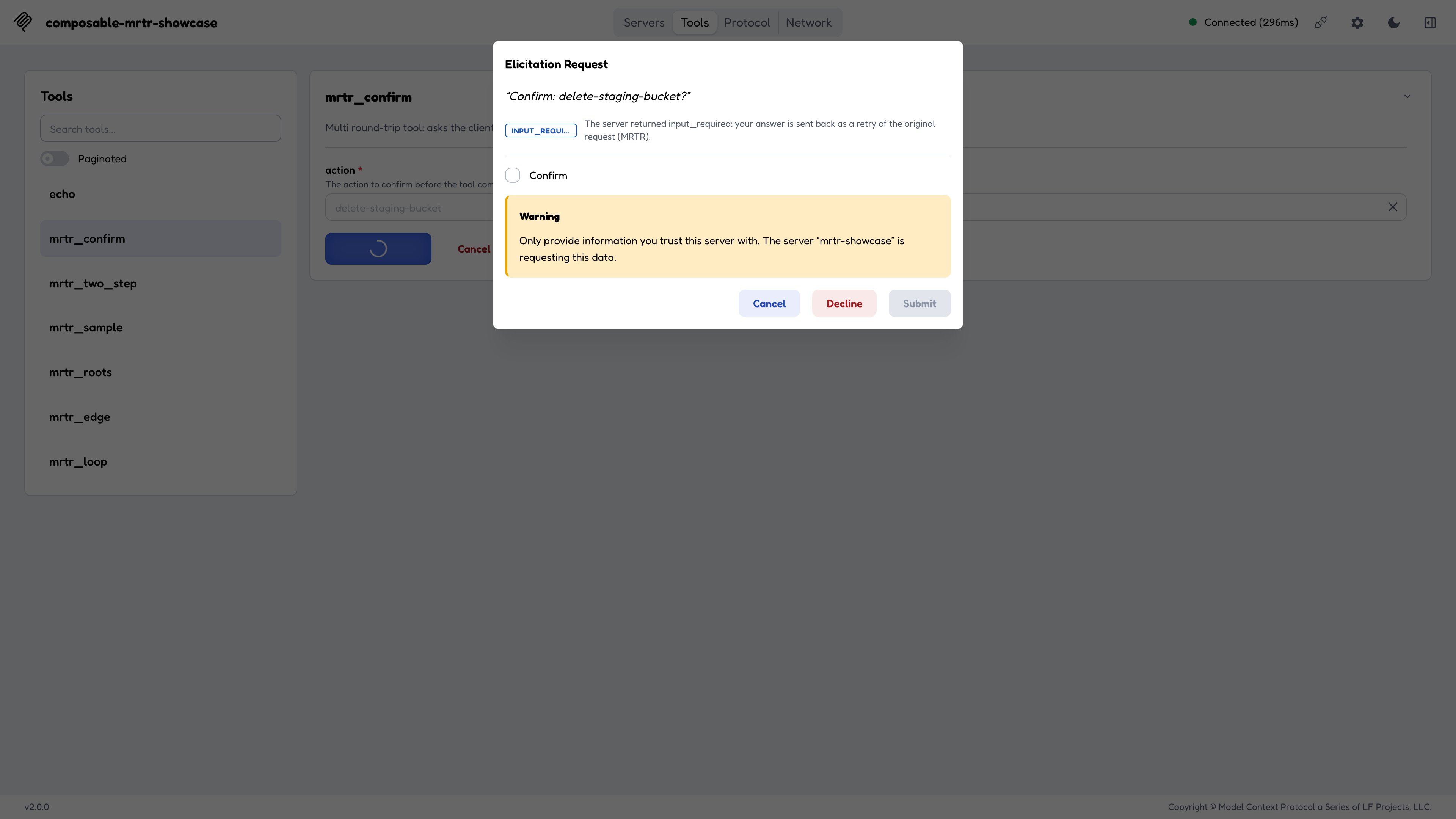
On the modern era a tool can return input_required instead of a final result, embedding an elicitation, a sampling request, or a roots/list request. The client answers that embedded request and retries the tools/call under a fresh JSON-RPC id until the call reaches complete.
The Inspector drives MRTR manually, so each round pauses at the pending-request modal, tagged input_required, for you to answer. The Protocol view groups the whole exchange as one MRTR conversation rather than as unrelated calls.
test-servers/configs/mrtr-showcase-http.json bundles every shape in one modern server:
| Tool | What it exercises |
|---|---|
mrtr_confirm | A single elicitation round. |
mrtr_two_step | Two elicitation rounds, threaded through requestState. |
mrtr_sample | An embedded sampling request, routed to the Sampling panel. |
mrtr_roots | An embedded roots/list, answered silently from configured roots (no modal). |
mrtr_edge | An inputRequests-only round, then a requestState-only round. |
mrtr_loop | Never completes, so the client stops at its MRTR_MAX_ROUNDS limit. |
<Note>
The legacy collect_elicitation pattern (a server calling
server.elicitInput) errors on a 2026-07-28 connection, because
server-to-client requests aren’t allowed there. MRTR is its modern
replacement.
Tools: mirrored headers and excluded tools
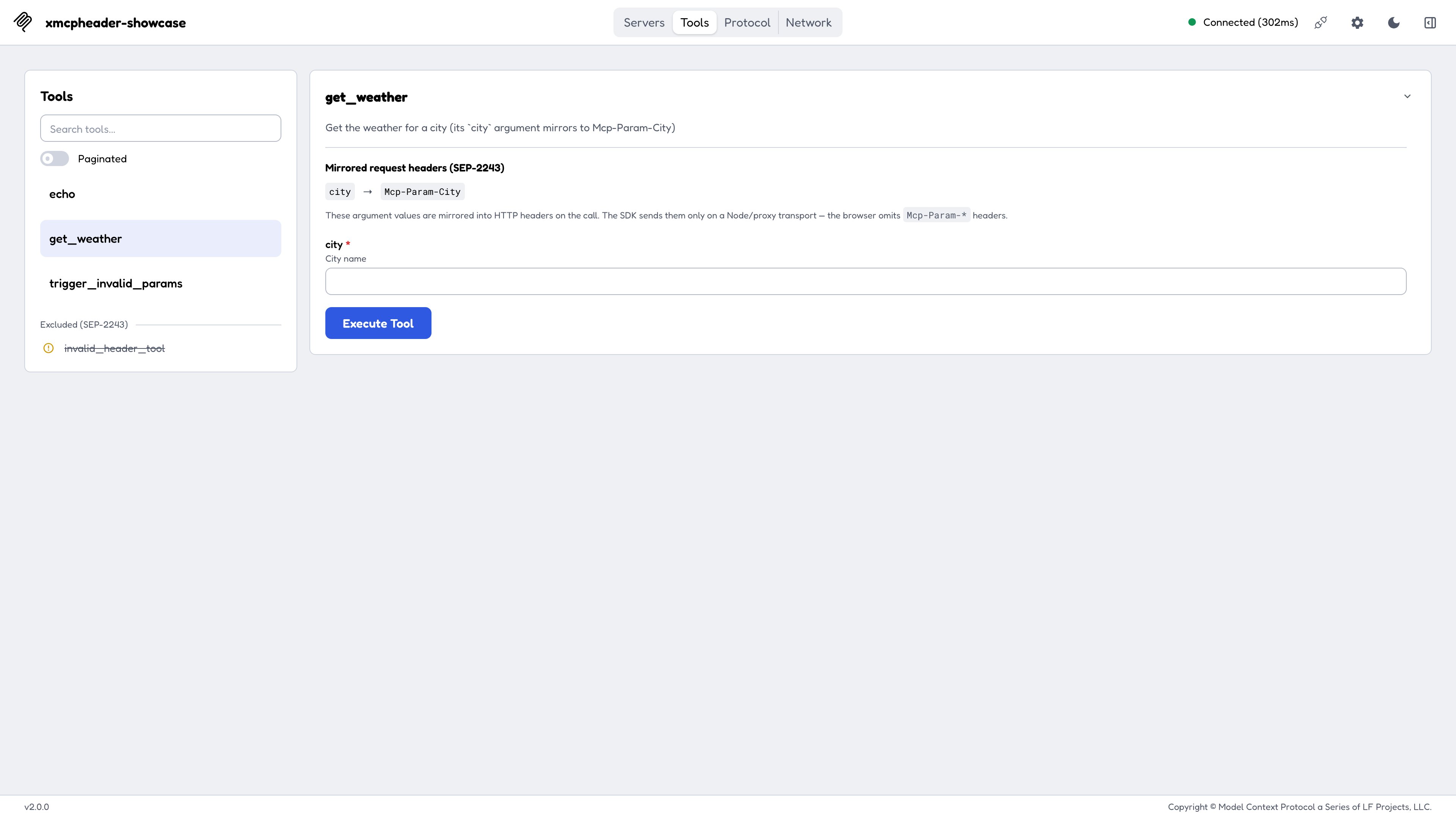
SEP-2243 lets a tool annotate an argument with x-mcp-header, asking a Streamable HTTP client to mirror that argument’s value into an Mcp-Param-* request header.
The Inspector surfaces both halves of that contract in the Tools tab:
- A tool with a valid annotation shows a “Mirrored request headers (SEP-2243)” section in its detail panel, for example
city -> Mcp-Param-City. - A tool with an invalid annotation (say, a header name of
"Bad Header", where the space makes it an invalid RFC 9110 token) appears struck through in the sidebar under an “Excluded (SEP-2243)” divider, with the reason on hover. A conforming client MUST drop such a tool fromtools/list; the Inspector shows you why it was dropped instead of silently hiding it.
Reproduce with test-servers/configs/xmcpheader-modern-http.json.
<Warning>
Mcp-Param-* mirroring is skipped by the SDK in the browser. Calling a
mirrored tool from the web client omits the header, so a strict server
answers -32020 (HeaderMismatch, see the error
taxonomy below). The
same tool called from the CLI or TUI, which both run on Node, mirrors
correctly. The header is dropped by an environment check inside the SDK,
outside the Inspector’s control.
-32602 error panels
Under the modern era a tools/call that rejects with -32602 renders as a distinct error panel:
- Unknown Tool: when the message names a tool the server does not list. Reproduce by calling any name absent from the server’s
tools/list. - Invalid Parameters: any other
-32602. Reproduce with thetrigger_invalid_paramstool in the config above.
Both eras reject with -32602; only the Inspector’s presentation changes. On a legacy connection you get one generic JSON-RPC failure and have to read the message to tell which case you hit.
Network and Protocol: headers and the error taxonomy
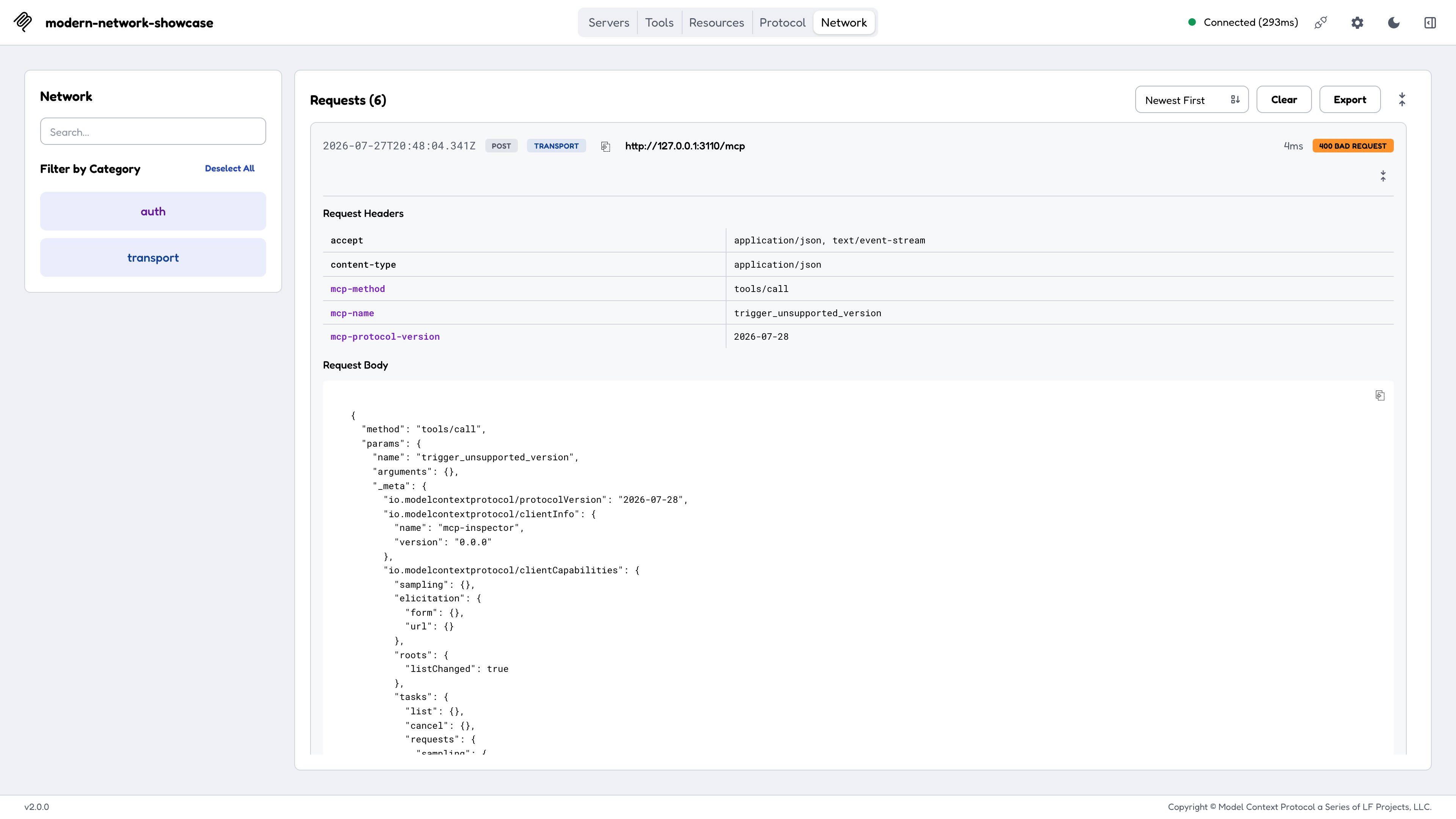
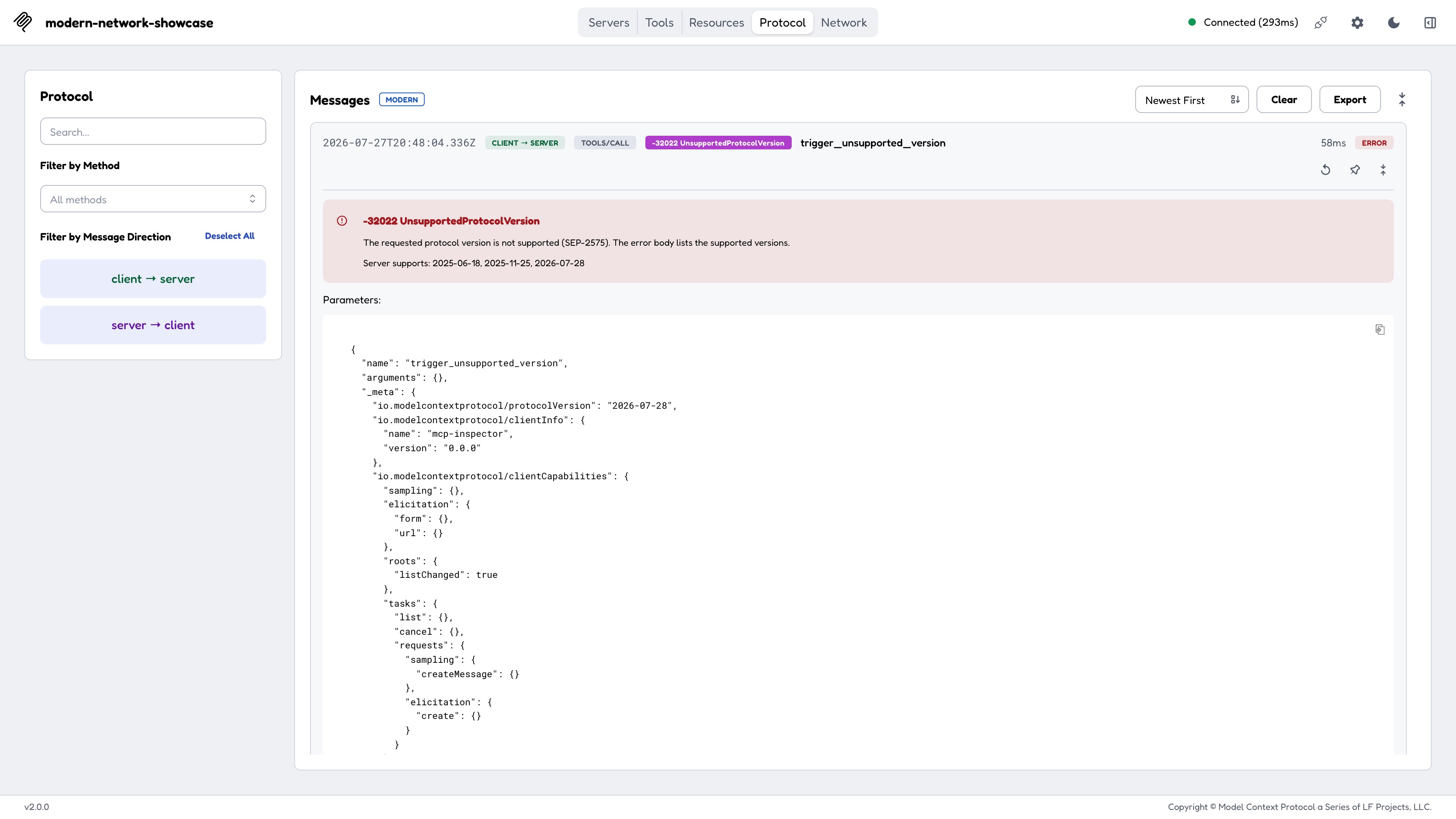
The modern era standardizes a set of Mcp-* HTTP headers and introduces a richer JSON-RPC error taxonomy (SEP-2243 / SEP-2575). The two monitoring tabs divide the work:
- The Network tab is the HTTP view: mirrored
Mcp-*headers are highlighted and sentinel values decoded. - The Protocol tab is the JSON-RPC view: each spec error renders distinctly rather than as a generic failure.
test-servers/configs/modern-network-http.json serves four tools that produce a real HTTP status plus a JSON-RPC error body, one per class:
| Tool | HTTP | JSON-RPC code | Meaning |
|---|---|---|---|
trigger_header_mismatch | 400 | -32020 | A required mirrored header was missing or wrong. |
trigger_missing_capability | 400 | -32021 | The request omitted a client capability the server requires. |
trigger_unsupported_version | 400 | -32022 | Unsupported version; supported versions in data.supported. |
trigger_method_not_found | 404 | -32601 | Method not found. |
Sessions
A legacy Streamable HTTP connection may carry a server-assigned session id (Mcp-Session-Id), which the client tears down with an HTTP DELETE. A modern connection is sessionless and per-request: with no session id the client SDK sends no DELETE to the server, so disconnect is purely local.
This has a practical consequence for your own test servers. A stateless modern handler constructed per request cannot hold state between calls, which is why test-servers/configs/subscriptions-modern-http.json, unlike its legacy counterpart, omits an update_resource tool: the mutation would run against a throwaway server instance and be invisible to the next read.
Last updated Oct 08, 2026